Speakers:
Jade D’Alpoim Guides, Scripps Institution of Oceanography & Department of Anthropology, University of California - San Diego
Xiaohua Gou, Dean of the College of Earth and Environment Sciences, Lanzhou University
James Pittock, Fenner School of Environment & Society, Australia National University
Gongbu Tsering, Southwestern University of Finance and Economics
Moderators:
Brendan Buckley, Lamont-Doherty Earth Observatory, Columbia University
Eveline Washul, Department of Central Eurasian Studies, Indiana University
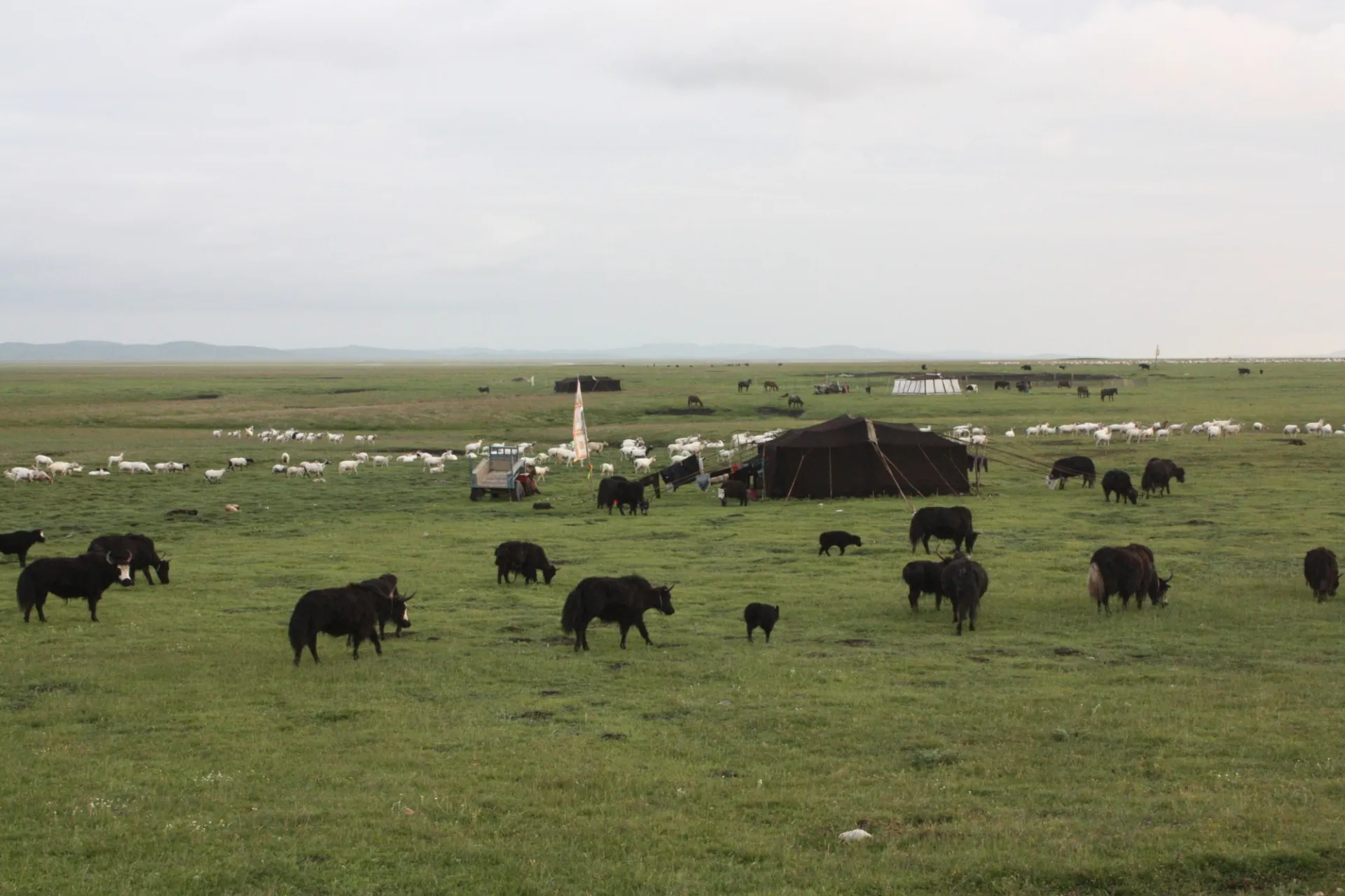
This roundtable features brief presentations by four scholars working in Qinghai, Gansu, Sichuan and Yunnan provinces. By modeling climate-driven limits on agricultural production, Dr. D'Alpoim Guedes will offer a deep history of human adaptation on the Eastern Tibetan Plateau. Dr. Gongbu Tsering will speak on rebuilding rural community cooperative institutions and their role in herder adaptation to climate change. Dr. Xiaohua Gou and Dr. James Pittock will present their research on climate variability in the region, and water resource management, respectively. A moderated discussion will follow.
Funding for this event was provided by the Weatherhead East Asian Institute at Columbia University and by the Inner Asian and Uralic National Resource Center at Indiana University.
Jade d’Alpoim Guedes is Associate Professor at the Scripps Institution of Oceanography & the Department of Anthropology at University of California San Diego, and an Affiliated Researcher at the Center for Climate Change Impacts and Adaptation. Her research focuses on the Tibetan Plateau, where she directs a multi-disciplinary, National Science Foundation (NSF) and National Geographic funded excavation project in the Jiuzhaigou National Park, Sichuan Province, China. She is also author of Monsoon Rains, Great Rivers and the Development of Farming Civilizations in Asia and an edited volume Method and Theory in Paleoethnobotany. Her research identified how and why a major transition in subsistence regimes took place on the Tibetan Plateau that resulted in a switch from farming systems based on millet to ones based on wheat and barley and agro-pastoralism.
Xiaohua Gou is Changjiang Distinguished Professor of Ministry of Education of China (MOE), Dean of the College of Earth and Environment Sciences at Lanzhou University, and Director of the MOE Key Laboratory of West China's Environmental System. Her research focuses on west China, particularly the Tibetan Plateau and surrounding areas. She explores past climate variability and its influence on ecosystem through tree-ring analysis. In her work, she has reconstructed the climate variation of different regions in arid and semi-arid areas of northwest China, including the first millennium streamflow reconstruction for the Yellow River. She found asymmetric variation of the maximum and minimum temperatures in the northeastern Tibetan Plateau, during the past several centuries. She also found that the warming had obviously promoted the climbing of the tree line.
James Pittock is a Professor at the Fenner School of Environment & Society at The Australian National University and co-convenes ANU's Masters of Climate Change program. His research focuses on environmental governance, climate change adaptation, energy and sustainable management of water. His current research focuses on the management of the Lancang and Dri Chu (Yangtze) rivers, specifically the nature and implications of dam construction and nature conservation. Prior to joining ANU, he worked for WWF International as Director of their Global Freshwater Program on conservation of wetlands, water use in agriculture, and river basin management.
Gongbu Tsering is an Associate Professor at Southwestern University of Finance and Economics. With a Ph.D. in range management, his research focuses on resource land management in pastoral areas of Sichuan Province. In addition, he has conducted field research in Yushu Tibetan Autonomous Prefecture, Qinghai Province and founded an NGO to promote the scientific value of traditional knowledge.