Ocean of Song & Dance: Emerging Currents in Tibetan & Himalayan Performance Studies
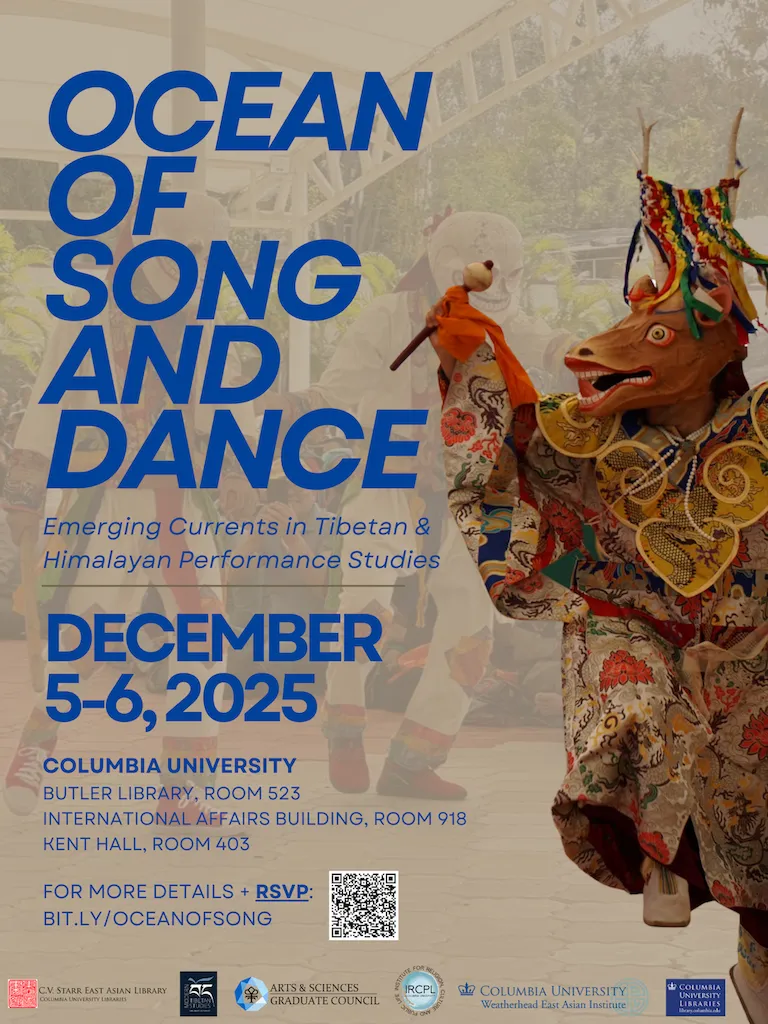
Ocean of Song and Dance brings together scholars, artists, and practitioners to explore the shifting currents of song, dance, ritual, and theatre across the Tibetan and Himalayan worlds. Featuring a keynote address by Jamyang Norbu and panels on performance, gender, and identity, the program also includes live, immersive demonstrations and participatory workshops on ache lhamo, or Tibetan opera. The conference highlights performance at the intersections of tradition and innovation, the sacred and the secular, and the local and the global, culminating in a participatory discussion on new directions for performance studies in Tibetan & Himalayan contexts. Through conversation, performance, and shared experience, Ocean of Song and Dance celebrates the creativity and interconnectedness of Himalayan expressive cultures, inviting reflection on the power of performance to carry history, shape identity, and inspire new cultural currents.
Click here to see the program.
Day 1 | December 5, 2025
- 2:30pm-4:00pm
- Table reading of Meeting the Madman, a play by Donald Lopez
- Butler Library, Room 523
- 4:00pm-4:45pm
- Tea break
- Butler Library, Room 523
- 4:45pm - 5:00pm
- Welcome / Constantine Lignos
- Butler Library, Room 523
- 5:00pm - 6:00pm
- Keynote Address: "The Quest for Cultural Authenticity" / Jamyang Norbu
- Butler Library, Room 523
- 6:00pm-7:15pm
- Dinner break
- Butler Library, Room 523
- 7:30pm - 9:30pm
- Demonstration: Ache Lhamo / Tenzin Kalsang, Namgyal Dolma, Tenzin Nyeden, Pema Tenzin, Isabelle Henrion-Dourcy
- Hamilton, Room 517
*For non-Columbia guests, registration is required to access the Morningside campus. Please RSVP by 12noon on Wednesday, December 3.
Day 1
Ache Lhamo Demonstration: This presentation, facilitated by Isabelle Henrion-Dourcy, aims at introducing the audience to the core elements of the art of singing Tibetan opera. After a short overview of Tibetan opera and its musical features, Tenzin Kalsang, Namgyal Dolma, Tenzin Nyeden, and Pema Tenzin will give a demonstration of the main vocal and melodic features of the opera. They will then invite the audience to practice basic skills of namthar (opera singing) and teach one song of the repertoire usually taught to beginners.
Jamyang Norbu is a Tibetan writer known principally for his essays on Tibetan politics and culture which regularly appear on his blogs Shadow Tibet, Rangzen.net and on Huffington Post. Some of his writings on Tibetan political writings have been published in three books: Illusion and Reality, Shadow Tibet and Buying the Dragon’s Teeth. His novel The Mandala of Sherlock Holmes won the prestigious Crossword Book Award, India’s equivalent of the Booker Prize, and has been published in over a dozen languages.
Norbu has also written a number of plays as well as a traditional Tibetan opera libretto, when serving as director of the Tibetan Institute of Performing Arts in Dharamshala. He also edited and contributed to the volume, Performing Traditions of Tibet. Norbu was a founding director of the Tibetan Centre for Advanced Studies, (the Amnye Machen Institute) which was twice awarded the Poul Lauretzen Freedom Prize of Denmark. Norbu edited the Institute’s Journal of History and Culture, Lungta, and also edited the Tibetan newspaper, Mangtso, published by the Institute. His latest work is Echoes From Forgotten Mountains: Tibet in War and Peace, published by Penguin, Random House. India.
Norbu was a former member of the Tibetan resistance movement in Mustang on the Nepal-Tibet border. He presently lives in Jackson Heights, NYC with his wife and two daughters. He also administers the High Asia Research Center at Jackson Heights.
Isabelle Henrion-Dourcy teaches Anthropology at Université Laval in Canada. She is a Tibetologist and anthropologist. She has investigated Tibetan popular culture over the last 25 years, looking at drama, pop music, dance, television, social media, cinema, and autobiographical writing. She seeks to understand cultural and political dynamics running through High Asia, the uses of cultural heritage, and the emergence of contemporary Tibetan cultural forms – both official and popular. She has written a long monograph on Tibetan opera, and edited three volumes on Tibetan performing arts and the anthropology of media.
Tenzin Kalsang, Namgyal Dolma, Tenzin Nyeden, and Pema Tenzin are all former artists of the Tibetan Institute of Performing Arts (TIPA) in Dharamsala, India, and are now residing in New York, actively taking part in teaching and introducing Tibetan culture to younger generations within Tibetan communities.
Day 2 | December 6, 2025
- 10:30am - 12:00pm
- Panel I: Text & Performance / Kimerer LaMothe, Constantine Lignos
- International Affairs Building 918
- 12:00pm - 1:15pm
- Lunch
- 1:30pm - 3:00pm
- Panel II: Gender, Ritual, and Performance / Kati Fitzgerald, Joshua Brallier
- International Affairs Building 918
- 3:00pm - 3:15pm
- Tea break
- International Affairs Building 918
- 3:15pm - 4:15pm
- Performance & Identity / Isabelle Henrion-Dourcy
- International Affairs Building 918
- 4:30pm - 6:00pm
- Initiation to Tibetan Folk Dance: A Participative Workshop Featuring Opera and Circle Dance (gorshay) / Tenzin Kalsang, Namgyal Dolma, Tenzin Nyeden, Pema Tenzin, Isabelle Henrion-Dourcy
- Lerner, Room 477
- 6:00pm - 7:00pm
- Concluding Discussion & Reception: New Directions in Tibetan & Himalayan Performance Studies
- Kent Hall 403
*For non-Columbia guests, registration is required to access the Morningside campus. Please RSVP by 12noon on Thursday, December 4.
Day 2
Text & Performance Panel
The Play of the Text: Rhythmic Bodily Movement and the Experience of Religious Meaning
Kimerer LaMothe
Within the study of religion, a tendency to privilege textual forms of religious expression and inward forms of religious experience has resulted in a paucity of conceptual resources for acknowledging the agency of human bodies in the production of religious meaning. In this panel, LaMothe shares her ecokinetic phenomenological approach to the study of religion. This approach understands religious systems and symbols, texts and rituals, as patterns of bodily movement, or “movement potentials,” which educate human senses to ranges of possible meaning and action. An ecokinetic approach offers myriad opportunities for revealing the originary and constitutive role that dancing in particular, and bodily movement in general, play in the world’s religions.
Incomplete Choreographies: Authorizing & Activating the Absent Body in Tibetan Buddhist Dance-Writing
Constantine Lignos
Beginning as early as the 16th century in Europe, the word choreography came to mask a certain anxiety around the two activities it brings together. Dancing (choreo-) is fluid, embodied, and ephemeral, whereas writing (-graphy) is fixed, disembodied, and symbolic. Without recourse to written documentation, without the ability to "capture" the body on the page, dance, it was feared, would forever be lost. This anxiety, however, is absent from Tibetan Buddhist dance texts dating back to at least the 13th century. Rather than attempting to preserve the entirety of a performance, these texts assume that the dance already lives in the body—or “in the bones”—of trained practitioners. Drawing on an archive of some 60 Tibetan Buddhist dance texts, I show how these writers created living texts that reside in the space between the body and the page. They do not record every step but rather authorize ritual lineage and activate embodied knowledge through cosmological framings, cues, and mnemonic prompts. By taking on performative functions, these texts do not merely document performance, but project ritual action forward, preserving memory even as they shape the future, summoning bodies, gestures, and worlds into being.
Gender, Ritual & Performance Panel
The Sound that is Heard Without Ears: Silence, Muteness and Mantra in the Songs of Khandro Tsulsang
Kati Fitzgerald
Khandro Tsulsang was a female Buddhist master who lived before, during and after the tumultuous period of the Cultural Revolution in Tibet. She was ordained as a nun, undertook a program of rigorous study and meditation, took a vow of silence, was imprisoned and targeted for struggle sessions, fled and was lost to her family members, teachers and students. After decades, she was rediscovered as a mute nun living in Lhasa. She composed a number of songs of realization during her periods of retreat, imprisonment and exile. These songs tell us important information about the kinds of meditative practices she was engaging, the female lineages she was upholding, as well as the poetic repertoire she had access to while in retreat. These songs also suggest an experiential knowledge of sound emptiness, which is evidenced through her own decades-long muteness, as well as her use of specific tonal vocabularies. Placing her poetic soundscapes in the broader context of her life and studies, I will consider Khandro Tsulsang’s extreme sensory deprivation in dark retreat, her refusal to speak, and her recitation of mantra and composition of songs of realization as an extension of her understanding of sound emptiness.
It Felt Like My Heart Was Torn Open: Masculinity and the Performance of Affect in the Autobiography of Do Khyentsé Yeshé Dorjé
Joshua Brallier
This paper proceeds from the question: what if we think about autobiographical writing as an act of performing the self? When we read autobiography as performance, in the J. L. Austin sense, we discover a rich trove of information about a subject’s gendered life. In this paper, I offer a translation and close reading of two affectively charged scenes in the autobiography of the famed nineteenth century master Do Khyentsé Yeshé Dorjé as a way of gaining insight into the gendered expression of emotion in the life writings of one of the most famous and enigmatic masters of nineteenth century eastern Tibet. The two scenes that I trace in this paper are the (re)union and (re)parting with Do Khyentsé’s tsawai lama, the first Dodrupchen Trinlé Öser. By tending to Do Khyentsé’s emotional language when remembering his first and last encounters with Dodrupchen in this life, we discover a gendered relationship to emotion that resists the dominant narrative circulating in Anglophone scholarship on men and masculinities, namely, that powerful men must restrain their emotion. In the case of Do Khyentsé, we discover a masculinity that enfolds emotional fluency within structures of power.
Performance & Identity Panel
Gorshay: Dancing Tibetan Identities in Tibet and Among the Diaspora
Isabelle Henrion-Dourcy
Circle dances (gorshay) are staple elements of Tibetan community celebrations. These traditional folk dances are known in all Tibetan communities in one form or another, with a great regional diversity in singing, musical instruments or dance movements. A new form of gorshay, on recorded pop music, emerged in Tibet at the end of the 20th century, became amplified through social media in the 2010s, and has taken by storm exile communities in South Asia and in the West in the early 2020s, to the point of replacing other performance traditions at major community gatherings. It has also been associated in exile with the White Wednesday (lhakar) movement.
While the widespread practice of gorshay among exiles has raised concerns about cultural authenticity, Chinese cultural influence, fragmentation along regional lines and transmission of Tibetan culture to the youth, in Tibet gorshay point more towards overcoming isolation in large urban centers and developing sophisticated social media strategies. On both sides, gorshay is seen as positive for both physical health (daily exercise) and mental health (cultivating joy), and as a way to preserve some form of Tibetan identity in difficult conditions.
Dance Workshop: This workshop, facilitated by Isabelle Henrion-Dourcy, aims at getting the audience on their feet and get an embodied sense of Tibetan movement at the end of this two-day conference. Within the vast and diverse corpus of Tibetan dance traditions, Tenzin Kalsang, Namgyal Dolma, Tenzin Nyeden, and Pema Tenzin will introduce one stylized dance, from the repertoire of Tibetan opera (the slow dance, dal thab) and one popular circle dance from the Stod region (toeshay, gorshay). Get into the groove and stamp the floor!
Kimerer LaMothe is a dancer, author, playwright, and philosopher of religion. She earned a PhD in Religion from the Graduate School of Arts and Sciences at Harvard University; taught at Brown and Harvard Universities for six years; and has received fellowships for her work in dance and religion from the Radcliffe Institute for Advanced Study, the Center for the Study of World Religions, both of Harvard University, and the Lower Adirondack Regional Arts Council (LARAC), three times. LaMothe is the author of six books, including Why We Dance (Columbia University Press); Nietzsche’s Dancers (Palgrave MacMillan), and Between Dancing and Writing: The Practice of Religious Studies (Fordham University Press).
Kati Fitzgerald is an Assistant Professor in the Department of Philosophy & Religion at Otterbein University. She is an anthropologist of religion, whose work focuses on the lives and religious experiences of the Buddhist laity. She uses primarily ethnographic methods in contemporary Tibet to understand the religious theories of everyday Buddhists. She teaches courses on Asian Religions, Ethics, Gender & Sexuality in the Study of Religion, the intersection between performing arts and religious practice, and religion and medicine.
Joshua Brallier is a doctoral candidate in Buddhist Studies at Northwestern University. His dissertation research considers the gendered dimensions of tantric ritual, narrative, and ideology in Tibetan Vajrayāna Buddhism, with particular interest in the role of masculinity in tantric Buddhist subject formation. His dissertation focuses on the life and writings of Do Khyentsé Yeshé Dorjé, the deer-hunting, alcohol-drinking, gun-wielding tantric master from the Golok region of eastern Tibet. He holds an M.A. in Buddhist Studies from the University of Colorado Boulder, an M.Div. in Indo-Tibetan Buddhism from Naropa University, and a B.A. in Religious Studies from Georgetown.
Constantine Lignos is a PhD candidate in East Asian Religions studying the role of performance in Tibetan Buddhist tantric ritual. His dissertation, Ritual Realities: Performance, Transformation, and Awakening in Tibetan Buddhist Tantric Dance, examines how performance becomes a mode of producing ontological and cosmological knowledge in Tibetan Buddhism. By reframing tantric Buddhism as a performative tradition in which awakening is enacted through embodied practice rather than merely represented in text, he analyzes tantric dance manuals and their transmission to show how texts function as active agents in choreographic processes, blurring the boundaries between archive and repertoire. He received a BFA in Experimental Performance and an MA in Performance Studies from NYU’s Tisch School of the Arts, along with an MA in Tibetan Studies from Columbia University.
Ocean of Song and Dance is co-sponsored by Weatherhead East Asian Institute, Arts & Sciences Graduate Council, Institute for Religion, Culture, and Public Life, C.V. Starr East Asian Library, Modern Tibetan Studies Program, and Columbia University Libraries.