Tibetan Education: Theory & Praxis (Workshop)
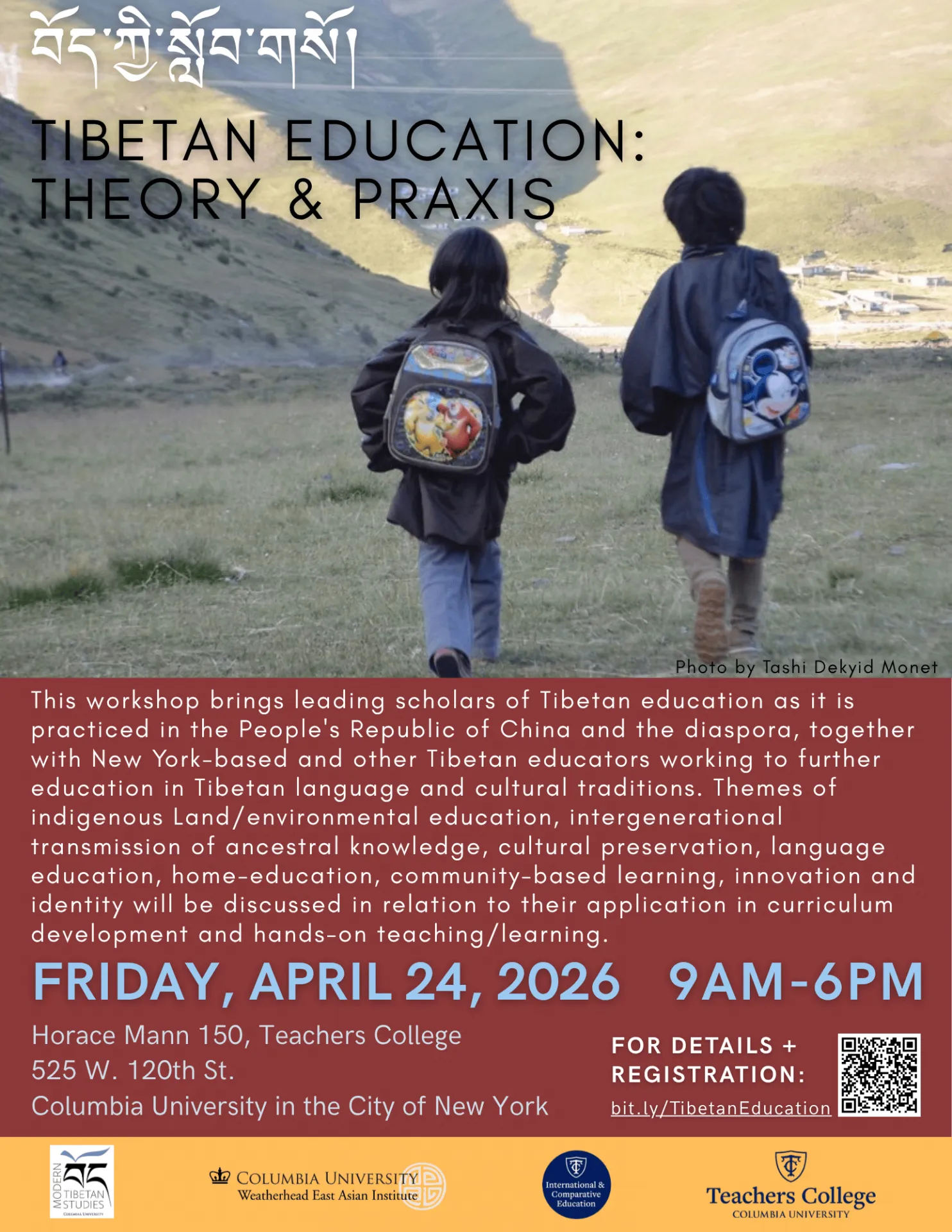
Tibetan education is a topic of critical importance and its practice is profoundly transnational. This workshop brings leading scholars of Tibetan education as it is practiced in the People's Republic of China and the diaspora, together with New York-based and other Tibetan educators working to further education in Tibetan language and cultural traditions. Themes of indigenous Land/environmental education, intergenerational transmission of ancestral knowledge, cultural preservation, language education, home-education, community-based learning, innovation and identity will be discussed in relation to their application in curriculum development and hands-on teaching/learning. We hope you will join us in these discussions!
Workshop Schedule
- Time & Location
- 8:30am
In-person - Event
- Morning Coffee & Guest Registration
- Time & Location
- 9am-10:30am
In-person & via Zoom - Event
- Panel Discussion 1: FORMAL EDUCATION
- Speaker(s)
- 1. Shamo Thar
(PhD, U-Mass Amherst)
2. Stuart Wright
(PhD, U-Sheffield, UK)
- Event
- BREAK (15 mins)
- Time & Location
- 10:45am-12:45pm
In-person & via Zoom - Event
- Panel Discussion 2: RETHINKING EDUCATION
- Speaker(s)
- 1. Tsepakjab Washul
(PhD, U of Virginia)
2. Tashi Dekyid Monet
(PhD, U of Virginia), Postdoctoral Scholar, WEAI, Columbia University;
3. Chime Dolma
Director of Global Studies, and History Faculty at Riverdale Country School; Co-Founder, YindaYin; M.A., Teachers College, Columbia
- Time & Location
- 12:45pm-2pm
Horace Mann 148 - Event
- LUNCH BREAK
- Time & Location
- 2pm-2:45pm
In-person & via Zoom - Event
- Panel Discussion 3: LANGUAGE & EXAMS
- Speaker(s)
- 1. Rebecca Clothey
Professor and Department Head, Global Studies and Modern Languages, Drexel University
2. Lingran Xie
PhD Student, Dept. of East Asian Languages & Cultures, Columbia University
- Time & Location
- 2:45pm-3:15pm
In-person & via Zoom - Event
- KEYNOTE REFLECTIONS
- Speaker(s)
- Prem Phyak
Associate Professor, Dept. of International & Transcultural Studies, International & Comparative Education Program, Teachers College, Columbia
- Event
- BREAK (15 mins)
- Time & Location
- 3:30pm-4:30pm
In-person & via Zoom - Event
- Panel Discussion 4: GRASSROOTS EFFORTS & INNOVATIONS
- Speaker(s)
- Yumten Rinchen Tara
YindaYin Coaching, NYC
and other invitees
- Time & Location
- 4:30pm-6pm
In-person only - Event
- BREAKOUT & CLOSING DISCUSSION
(all presenters) - Speaker(s)
- How to support each other and collaborate on teaching Tibetan language & culture?
- Time & Location
- 7pm-9:30pm
Lenfest Center
for the Arts
615 W 129th St
New York, NY - Event
- FILM SCREENING
- Speaker(s)
- Feature Documentary
Daughter of Light (2024)
followed by discussion with director, Khashem Gyal, WEAI Artist in Residence
To reserve tickets, register here.
Chime Dolma. Director of Global Studies and History Faculty at Riverdale Country School; Co-Founder and President at YindaYin Coaching Center. Chime holds an MA from Teacher's College, Columbia University and B.A from Middlebury College, where she double majored in Political Science and Chinese Language. Since 2022, she has also served on the Advisory Council at the Rubin Museum.
Rebecca Clothey (Ph.D., International Development in Education Program, University of Pittsburgh, 2004) is a Professor and Head of the Department of Global Studies and Modern Languages at Drexel University. She is an interdisciplinary scholar whose research interests explore the politics of knowledge, with a focus on education policy, ethnicity, and community-driven education initiatives in China, the U.S., and Türkiye. Her passion for international education began while attending an international boarding school in Tamil Nadu, South India as a youth, and her global interests have continued to expand ever since. She has lived for extended periods in India, China, Türkiye, the United States, and Bosnia-Herzegovina.
She has authored over 40 articles and book chapters, and co-edited 4 books. Her research has been funded by grants from Fulbright, including one to China and one to Uzbekistan; the Spencer Foundation; NEH-ARIT; Foreign Language and Area Studies (FLAS) and the Drexel Social Science Research Fund among others. In 2021-2022, she was awarded the Drexel University Provost Award for Outstanding Mid-Career Scholarly Achievement. She was elected to serve as the Vice President of the Comparative and International Education Society for the 2026-2027 academic year.
Tashi Dekyid Monet (མོ་ངེ་བཀྲ་ཤིས་བདེ་སྐྱིད།) (Ph.D., Education from the University of Virginia, 2024) is a Tibetan scholar, writer, and translator whose academic and literary work explores Indigenous Land-based traditions, multispecies justice, and the intersections of literature, spirituality, and the environment. Born and raised in Minyak Rabgang in eastern Tibet, she earned her BA in Tibetan Literature from Minzu University of China. Her dissertation research connects Tibetan literary and oral traditions of Land, Buddhist sacred geography, Indigenous storytelling, popular culture—art, music, literature, and film—with global conversations on decolonial methodologies, critical Indigenous education, human geography, environmental humanities, and multispecies justice. Currently, she is a Postdoctoral Scholar (2025- 2026) at the Weatherhead East Asian Institute at Columbia University where she is co-leading the project “Indigenous Knowledge and Climate Change on the Tibetan Plateau and the Himalayas” with the Modern Tibetan Studies Program. She aspires to explore and collaborate on comparative studies of high mountain Indigenous communities from the Tibetan Plateau and the Altai to the Andes to understand their lifeways, strategies, and aspirations for environmental ethics, cultural regeneration, and multispecies care.
Prem Phyak (Ph.D., Second Language Studies, The University of Hawaiʻi at Mānoa, 2016) is Associate Professor in International and Comparative Education in the Department of International and Transcultural Studies at Teachers College, Columbia University. His work broadly explores the intersection of language, society, and education, critically examining how global ideologies (e.g., neoliberalism and development) shape the creation and implementation of local language policies and plans in education. Methodologically, he adopts ethnographic and participatory approaches to collaborate and engage in dialogue with Indigenous communities (parents, youth, and activists), teachers and teacher educators, policymakers, and NGOs. He is co-author of Multilingual education in South Asia: At the intersection of policy and practice (Routledge, 2022); Innovative technologies and pedagogical shifts in Nepalese higher education (Brill/Sense, 2021); and Engaged language policy and practices (Routledge, 2017).
Shamo Thar (Ph.D., International Education, University of Massachusetts Amherst, 2023) is a sociologist of education and a Visiting Scholar at Department of International and Transcultural Studies, Columbia University. She previously held a postdoctoral research position at SOAS, University of London. Her research examines the intersections of international education, language policy, transnational mobility, and higher education, exploring questions of identity, belonging, and place-making for Tibetans in China’s ethnic borderlands and across transnational spaces. Her scholarship has been recognized with honors including the Margaret McNamara Education Grant, the Ambassador Cynthia Shepard Perry Award, and the Scholarly Excellence Award.
Applying decolonial and social justice lenses, her current projects investigate multispecies relationality in multilingual education and the ideological and implementation spaces of Indigenous languages in language policy. Her work has appeared in the Journal of Diaspora, Indigenous, and Minority Education and other publications. Beyond academia, Dr. Shamo Thar is a published author of children’s books and has extensive leadership experience in the nonprofit and higher education sectors. She earned her Ph.D. in International Education from the University of Massachusetts Amherst.
Tsepakjab Washul (དབལ་ཤུལ་ཚེ་དཔག་སྐྱབས།) (Ph.D., School of Education and Human Development, University of Virginia, 2026) is a Tibetan scholar of education. He earned his PhD from the School of Education and Human Development at the University of Virginia (2026). His dissertation is titled Children’s Education in Practice: Human, Non-human Worlds, and Social Transformations in a Pastoralist Community in Tibet. His research interests include situated learning, education in practice, embodied knowledge, learning in everyday practice, and education in home and community settings. His writings include “Translating Western Academic Research and Methods into Tibetan” (Yeshe, 2024). “Learning to Think Like an Anthropologist? A Comparison of Student Learning in Online vs. Face-to-Face Anthropology of Education Courses” (co-authored, Teaching Anthropology, 2025), and “What is Social Entrepreneurship? Conceptualizing Business for Good in Tibetan Contexts” (Social Entrepreneurship on the Plateau, Tibetan language blog, 2023). He organized a series of workshops with Tibetan teachers translating academic literature in education from English to Tibetan (2023). Tsepakjab was born and raised in a pastoralist community in northeastern Tibet. Prior to beginning his doctoral studies, he worked for many years in cultural documentation projects on the Tibetan Plateau. He also co-founded Charu Co-Working Space in Chengdu that supported emerging young Tibetan entrepreneurs.
Stuart Wright (Ph.D., School of East Asian Studies, University of Sheffield, 2019) is currently a Research Associate affiliated with the Oxford School of Global and Area Studies (OSGA); he was previously a Leverhulme Early Career Fellow in OSGA, working on the project “Education-as-development”: Minorities and state education in western China (2022–2025). Before joining OSGA, Stuart spent more than two years teaching courses in sociocultural anthropology, minorities and sociocultural change in western China, and international development, at the City University of New York (Brooklyn College and City College). His doctoral dissertation is titled “Governing Social Change in Amdo: Tibetans in the Era of Compulsory Education and School Consolidation”, which he is developing for publication following postdoctoral fieldwork in 2024.
Lingran Xie is a Ph.D. student in the East Asian Religion program. Her research interest focuses on monasticism in central Tibet (Lhasa and Shigatse), Sino-Tibetan relations during the modern era, and Buddhist modernity in China. She wrote her M.A. thesis on how Lhasa’s Drabzhi Lhamo Temple (གྲྭ་བཞི་དགོན་), a Tibetan Buddhist female treasure deity temple, has encountered Buddhist modernity. In the summer of 2023, through field studies, she examined the history of Drabzhi Lhamo Temple and its locative area Drabzhi Thang (གྲ་བཞི་ཐང་) during the reigns of the Yongzheng Emperor and the Qianlong Emperor of the Qing Dynasty, explored the possible explanation of Grabzhi Lhamo’s origin and identity, and analyzed factors contributing to Drabzhi Lhamo’s recent rise in popularity.
She received her B.A. in Religious Studies and Asian Studies from DePauw University and her M.A. in East Asian Languages and Cultures (EALAC) from Columbia University. At DePauw, her research broadly included analysis of pre-modern and modern Chinese literatures, relations between the Chinese government and religions in the contemporary era, and the political significance of religious imageries in modern Tibetan history. Before joining the M.A. program at EALAC, she worked for two years as a research assistant at Yak Museum of Tibet in Lhasa, where she conducted field research on the city’s monasteries.
Yumten Rinchen Tara (རིན་ཆེན་ཏཱ་ར།) is an early childhood education specialist, children’s book author, and curriculum designer dedicated to advancing the educational and cultural development of Tibetan children in the diaspora. Born into a semi-nomadic family in Amdo, Tibet, she pursued her education across India, Norway, and the United States, earning an M.A. in International and Comparative Education from Teachers College, Columbia University and a B.A. from Duke University. She is the author of three Tibetan–English bilingual children’s books designed especially for Tibetan children born and raised in the West, with the goal of nurturing their cultural identity and strengthening heritage language connections among young learners.
At YindaYin Coaching in Queens, New York, Rinchen works closely with Tibetan families and children to support educational growth, social-emotional development, and youth empowerment. Her teaching and curriculum design are grounded in inquiry-based and experiential learning, emphasizing hands-on exploration, creativity, and culturally responsive practices that connect learning to children’s cultural identities, family traditions, and lived experiences. During her leisure time, Rinchen enjoys exploring the beauty of nature through photography and art-making, and nature remains a deep source of inspiration in her teaching practices.
This workshop is made possible by funding from the Weatherhead East Asian Institute and MTSP donors, and is organized in cooperation with YindaYin Coaching.